













Tamil Nadu has more factories than any other Indian state, employs more factory workers than any other, and now ships about two of every five dollars of India’s electronics exports. When a new state government took office in May 2026, the question for foreign manufacturers was whether that momentum would hold. Five months on, the answer is yes. Existing investors are adding capacity, new ones are arriving, and the state has moved quickly to speed up approvals.
The sharper finding is about competition. Tamil Nadu’s pull is intact, but its own anchor investors now also build elsewhere. Hyundai, the company most closely tied to Chennai, opened its first car plant outside Tamil Nadu, near Pune, in October. The state is no longer competing for attention. It is competing for each expansion, against rivals that are bidding hard for the same companies.

The money kept coming
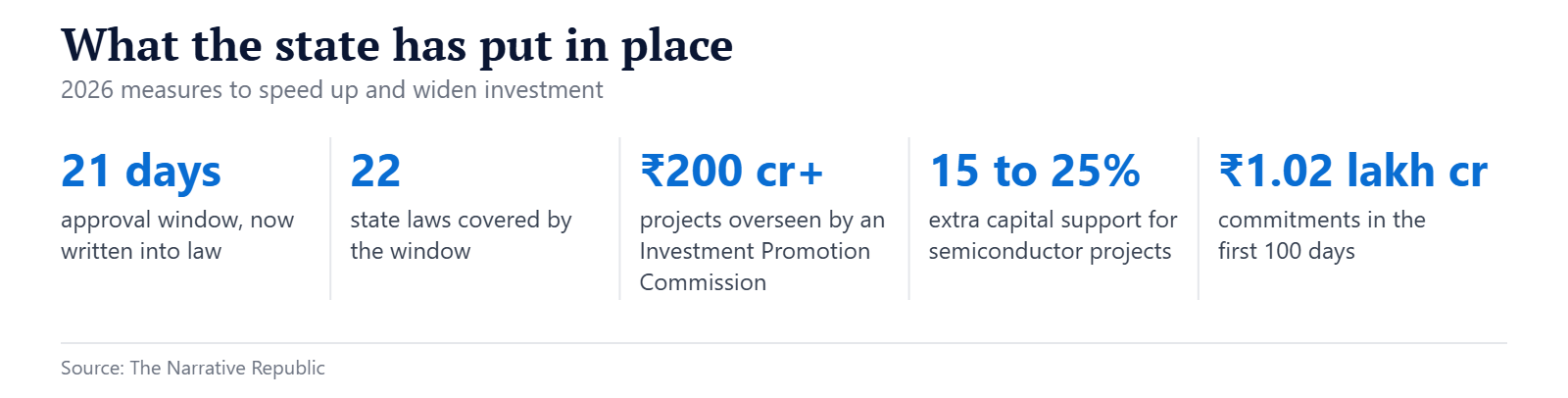
The new government’s first big test was its investors conclave in Chennai on 13 August. It produced 97 company agreements worth ₹67,452 crore, with projected employment of 1,06,998. Including other agreements signed in its first 100 days, the state counted ₹1,02,514 crore of commitments.
The foreign names were mostly existing investors adding capacity, which is the strongest vote of confidence a state can get. Daimler India Commercial Vehicles signed an agreement for ₹4,000 crore to expand at its Oragadam site, covering product development, research and development and manufacturing. Saint-Gobain committed about ₹2,000 crore for a new plant in Krishnagiri and an expansion in Kanchipuram. Japan’s YKK committed ₹1,651 crore in Tiruvallur for zippers and fastening products, with an estimated 4,316 jobs.
The flow has been steady. Japan’s MinebeaMitsumi had signed for ₹1,980 crore in February, before the change of government. A state delegation to the United Kingdom in September secured commitments including about ₹11,000 crore from India’s Samvardhana Motherson and a ₹1,000 crore capability centre from EY. In October, CapitaLand India Trust inaugurated a data centre at Ambattur, an investment of about ₹1,940 crore designed for 53 MW of power, and on 29 October the state cabinet approved incentive packages for eight more projects worth ₹3,767 crore.

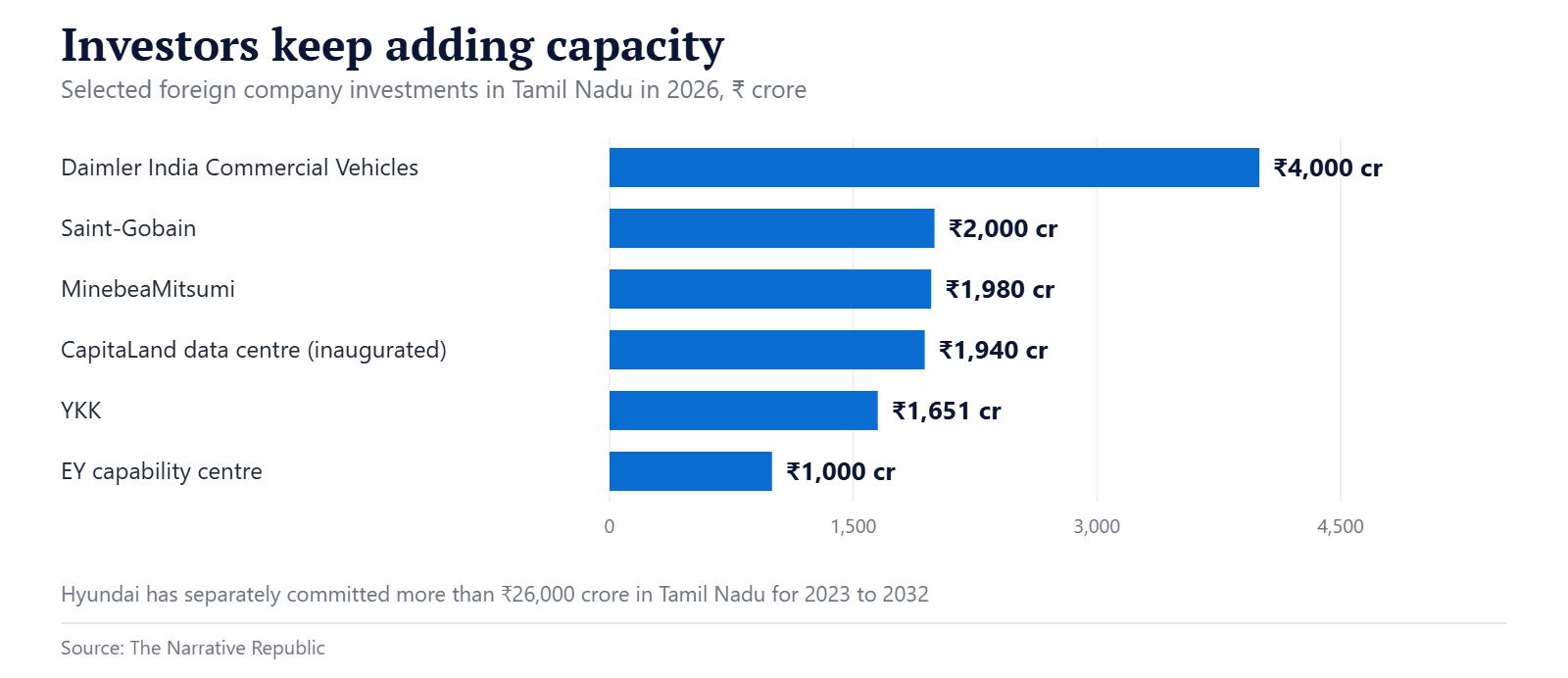
Hyundai itself has deepened its Tamil Nadu commitment. In June 2026 it named the state its flagship electric vehicle hub, with more than ₹26,000 crore committed in Tamil Nadu between 2023 and 2032 and local sourcing of 82%, targeting 90%.
What makes Tamil Nadu hard to beat
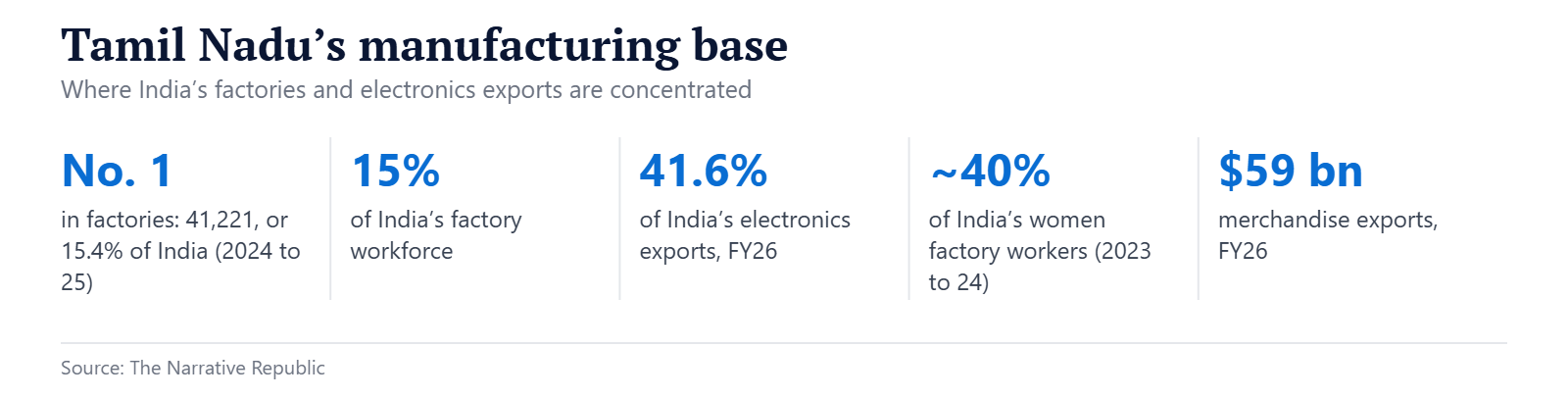
The base is broad and deep. The latest Annual Survey of Industries, released in September 2026, ranks Tamil Nadu first in India with 41,221 factories, 15.4% of the national total, and first in factory employment with about 15% of the country’s factory workforce. By the state’s own estimates, it makes about 35% of India’s auto components, a quarter of its cars, more than a third of its two wheelers and nearly 60% of its electric two wheelers.
Its workforce is a distinct advantage. About 40% of the women directly employed in India’s factories work in Tamil Nadu, including about 43% of the women working in electronics factories. That depth of trained workers, many of them women, is one reason electronics assemblers have scaled so fast in the state.
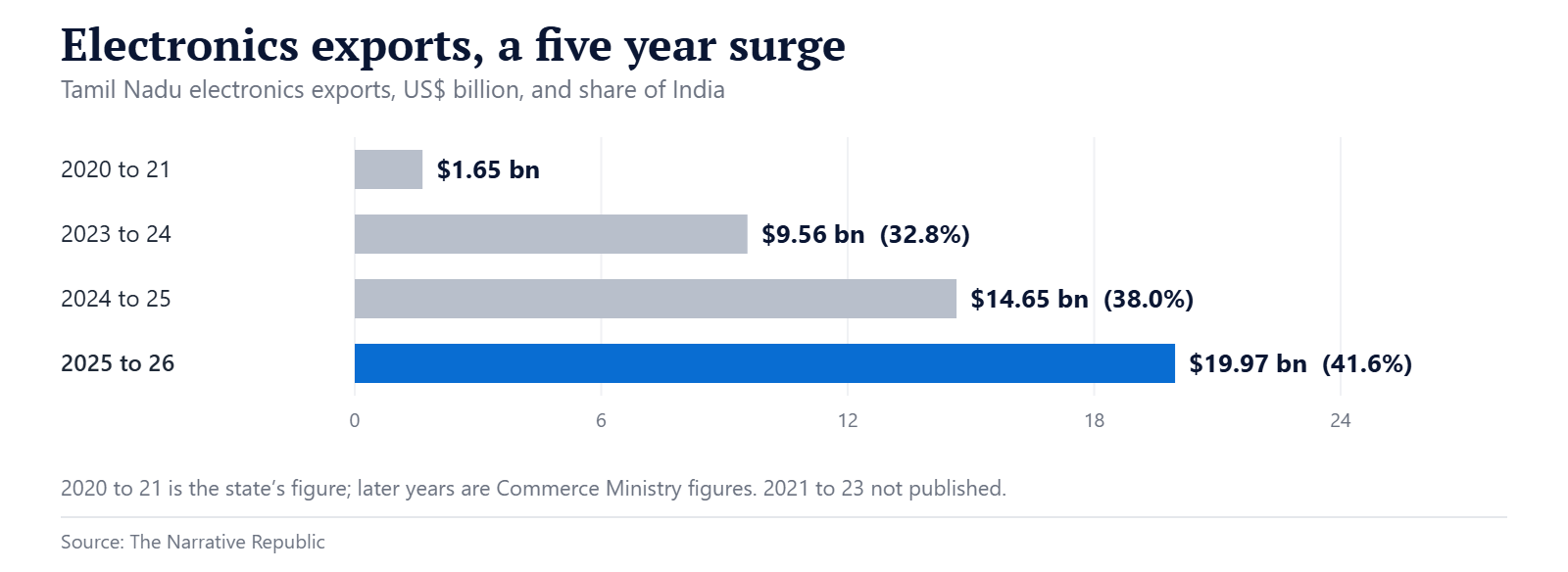
Exports carry the case. Tamil Nadu’s electronics exports rose from $1.65 billion in 2020 to 2021, by the state’s count, to $19.97 billion in 2025 to 2026, about 41.6% of India’s total, according to the Union Commerce Ministry. The state’s total merchandise exports reached about $59 billion in 2025 to 2026, growing faster than any other state’s, and Kancheepuram district alone shipped $26.4 billion, second only to Jamnagar among India’s districts.

Foxconn sits at the centre of the electronics story through its iPhone assembly at Sriperumbudur. In October 2025 the state announced a fresh ₹15,000 crore commitment from the company, expected to create about 14,000 engineering jobs.
Services are growing alongside the factories. A December 2025 industry report counted more than 250 global capability centres in Tamil Nadu, with Chennai holding about a tenth of India’s total, and Coimbatore has grown into a second hub with more than 60. The state partnered with GCC builder ANSR in November 2025 to attract more, the new government has named capability centres as a priority sector, and EY’s ₹1,000 crore centre is the latest addition. Centres in the city are tracked in our guide to GCCs in Chennai and on our India GCC Tracker.
What the state is doing
The new government has moved fast on the thing investors complain about most: time. In September the Assembly passed an amendment to the state’s business facilitation law, in force from mid October, that sets a 21 day window for approvals, licences and no objection certificates across 22 state laws. Large projects, above ₹200 crore or 5,000 jobs, are overseen by an Investment Promotion Commission chaired by the Chief Secretary.
It is also widening the base. In October the state launched a Semiconductor Ecosystem Scheme that adds 15% to 25% of capital costs on top of central support, and in August it announced a semiconductor park at Maduramangalam. A shipbuilding policy issued in March is already in place, new industrial parks are planned in Thoothukudi including an electric vehicle park at Sillanatham, and the government has said a new industrial policy will name petrochemicals, shipbuilding, semiconductors, AI, space technology and capability centres as priorities. On infrastructure, the 133 km Chennai Peripheral Ring Road is being built in phases with funding from Japan’s JICA, opening up new industrial corridors around the city. The state’s policy approach is summarised on our Tamil Nadu policy page.
Where rivals are catching up
Hyundai’s new plant shows the competitive reality. On 14 October Hyundai opened its plant at Talegaon near Pune, starting at 170,000 units a year and planned to reach 320,000 by 2030, backed by up to ₹11,000 crore in phases. Its Venue compact SUV is built only at Pune, with exports planned to more than 35 countries. Chennai, with capacity of 824,000 units and a record of four million cars exported since 1999, remains Hyundai’s larger base by far, and the company’s electric future is anchored in Tamil Nadu. But an export model now being made in another state is a reminder that no anchor’s next plant is automatic.
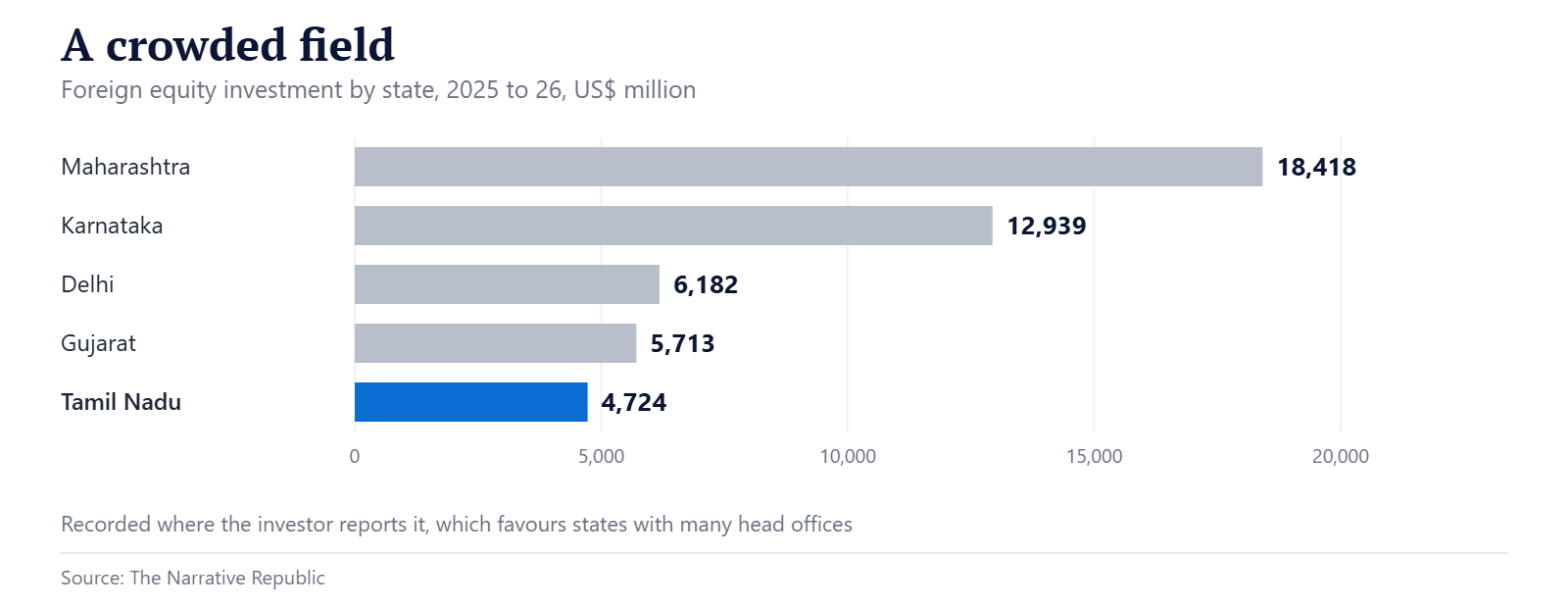
The investment tables point the same way. India received $58.84 billion of foreign equity investment in 2025 to 2026. Tamil Nadu’s share rose 28% to $4,724 million, a healthy gain, but it ranked fifth behind Maharashtra, Karnataka, Delhi and Gujarat. Karnataka’s inflow almost doubled. These tables record investment where the investor reports it, which favours states with many corporate head offices, but the direction is clear: the field is crowded.

Semiconductors are a gap to close. Gujarat now hosts six centrally approved chip projects and Uttar Pradesh one, while Tamil Nadu has none yet. The new state scheme and the Maduramangalam park are designed to change that, but the first approval will be the real signal.
Where the gaps are
Land is the first constraint. A recent study for the real estate developers’ body found that state industrial park land is close to fully used in several hubs, with very little left in Coimbatore and Madurai, and that only about 35% of committed projects were operational. Faster approvals help only if ready land is available to approve.
Power is the second. Peak demand reached a record 21,724 MW in July 2026, and the state utility expects more than 23,000 MW next summer. Supply has kept pace so far, but large factories and data centres will need reliable connections and competitive tariffs as demand climbs.
Concentration is the third. Kancheepuram district alone accounts for close to 45% of the state’s exports, much of it from a handful of electronics and auto anchors. That concentration is a strength while those anchors grow, and a risk if their next expansions go elsewhere.
Value addition is the fourth. Tamil Nadu ranks first in factories and factory jobs but third in industrial value added, at about 10.9% of India’s total. Much of the electronics boom is still assembly. Moving into components, semiconductors and design would raise the value created per worker, and that is exactly where the state’s new schemes are aimed.
What both sides gain
For investors, Tamil Nadu offers a rare combination: a large, skilled and diverse workforce, ports and supplier networks built over decades, including more than 1,500 auto component factories, and a government that has just written faster approvals into law. Repeat investors know the system from the inside, which is why so many of this year’s commitments came from companies already there.
For the state, each new plant adds jobs, exports and suppliers, and keeps it at the centre of India’s manufacturing push as the country tries to capture more of global supply chains.
What to watch
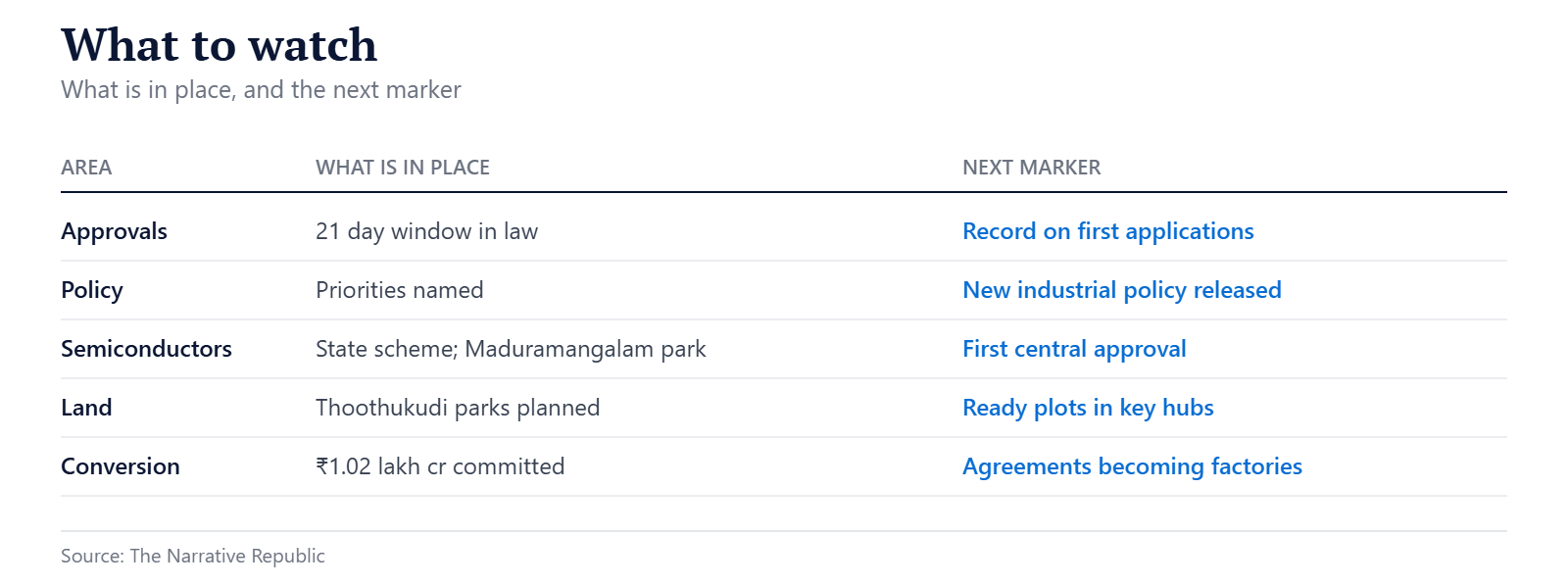
Three markers will show how the next phase goes: the release of the new industrial policy, the state’s first centrally approved semiconductor project, and how quickly the agreements signed this year turn into working factories.

Tamil Nadu has passed its first test under a new government, with capital still arriving and approvals getting faster. What has changed is that every expansion must now be won. With its workforce, exports and track record, the state goes into those contests with one of the strongest hands in India.
Also read: Hitachi Energy’s Seven Decade India Bet Is Paying Off. The Next Test Is Delivery