

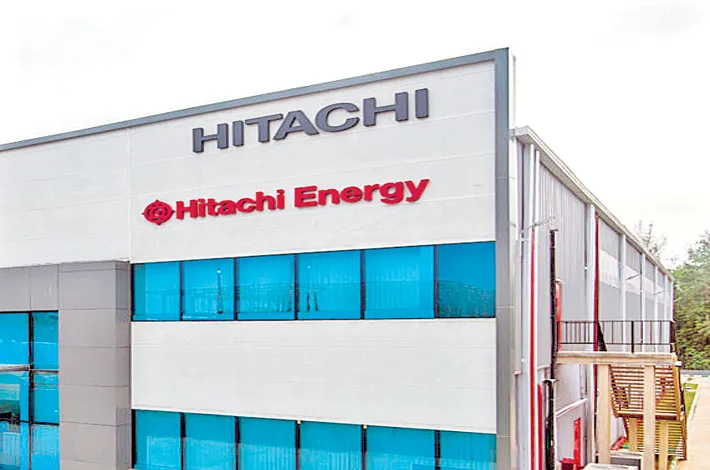
Few foreign companies are as woven into India’s power grid as Hitachi Energy. Its roots here go back to 1949. It opened its first factory in Vadodara in 1962, and today its technology sits inside more than half of the country’s high voltage direct current links, the long distance lines that move bulk power between regions.
That long presence is now paying off. India’s push to build transmission for 500 GW of clean power has turned Hitachi Energy India into one of the fastest growing companies in the sector. Revenue rose by more than half in two years, profit grew about six times, and the order book stands at a record ₹32,222 crore. The question for the next phase is not demand. It is whether factories, engineers and suppliers can deliver the work on time.
From Hindustan Electric to Hitachi Energy
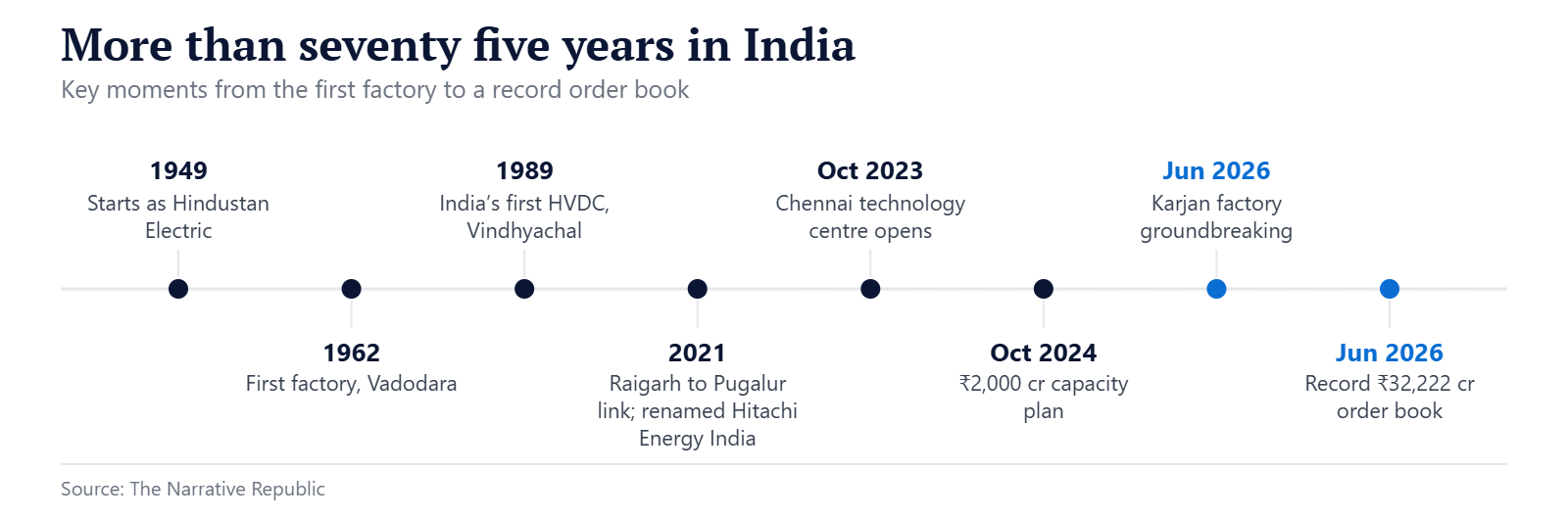
The business has changed names more than its address. It started as Hindustan Electric and later carried the Brown Boveri and ABB names. In December 2019 the power grids business was separated from ABB India and listed in March 2020. Hitachi took 80.1% of ABB’s global power grids business in July 2020, the Indian company was renamed Hitachi Energy India in late 2021, and Hitachi bought the remaining global stake in December 2022.
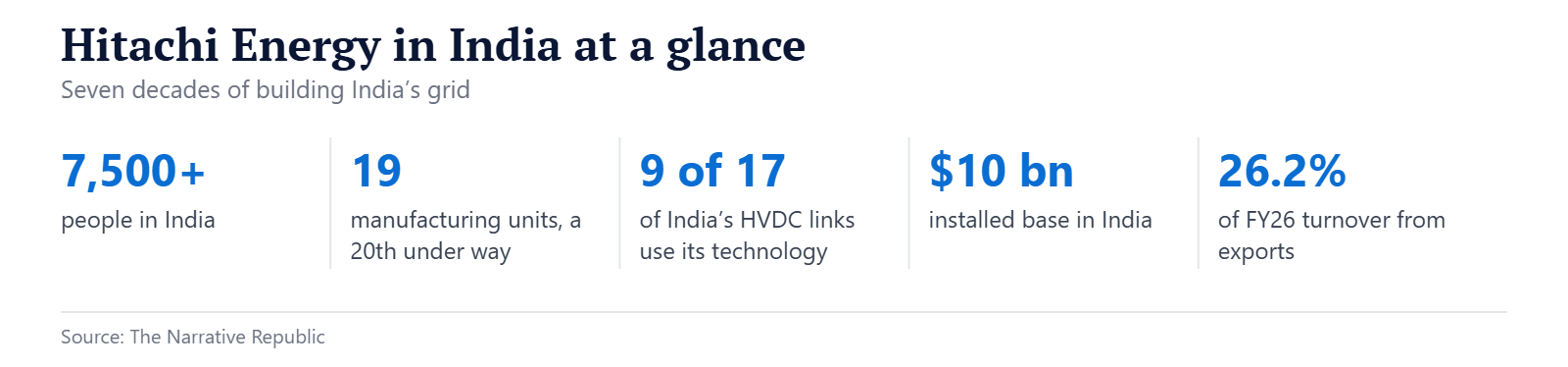
Through those changes the engineering base stayed. The company delivered India’s first HVDC project at Vindhyachal in 1989 and the first long distance link, Rihand to Delhi, in 1990. In 2021 it commissioned the ±800 kV Raigarh to Pugalur link with BHEL, a 6,000 MW line of about 1,800 km built for Power Grid.
Hitachi Energy is headquartered in Zurich and owned by Japan’s Hitachi, which makes it part of two investment stories at once: the Swiss companies building in India and the wider Japanese presence. Its company profile in our directory tracks the full footprint.
What it has built for India
The footprint is large. Hitachi Energy has more than 7,500 people in India across its two entities, 19 manufacturing units in eight locations with a 20th under construction, about 3,000 energy transition technologists and an installed base it values at $10 billion. Its power automation runs in most of India’s metro rail systems, and it has worked with Indian Railways on Scott transformers for high speed rail.
India is also an export base. Exports made up 26.2% of the listed company’s turnover in 2025 to 2026, reaching more than 70 countries, and they made up a third of orders outside HVDC in the April to June 2026 quarter. Its Chennai HVDC factory is building converter equipment for export, including for the Marinus Link between Tasmania and mainland Australia.
Chennai is the company’s engineering engine. Its Global Technology and Innovation Centre, inaugurated by the Tamil Nadu chief minister in October 2023, covers 300,000 sq ft including nearly 50,000 sq ft of laboratories, and opened with more than 2,500 technologists working on over 1,000 projects a year across 40 countries. The centre is tracked on our India GCC Tracker and features in our guide to GCCs in Chennai.
The work goes well beyond support. The centre brings engineering, research and development, project management, tendering, supply chain, commissioning, system studies, cybersecurity and remote services under one roof, and its technologists specialise in grid automation, transformers, high voltage equipment and grid integration. The company describes it as handling end to end engineering of global projects for Hitachi Energy units worldwide, which makes Chennai part of how the group builds grids far beyond India.
The numbers behind the bet
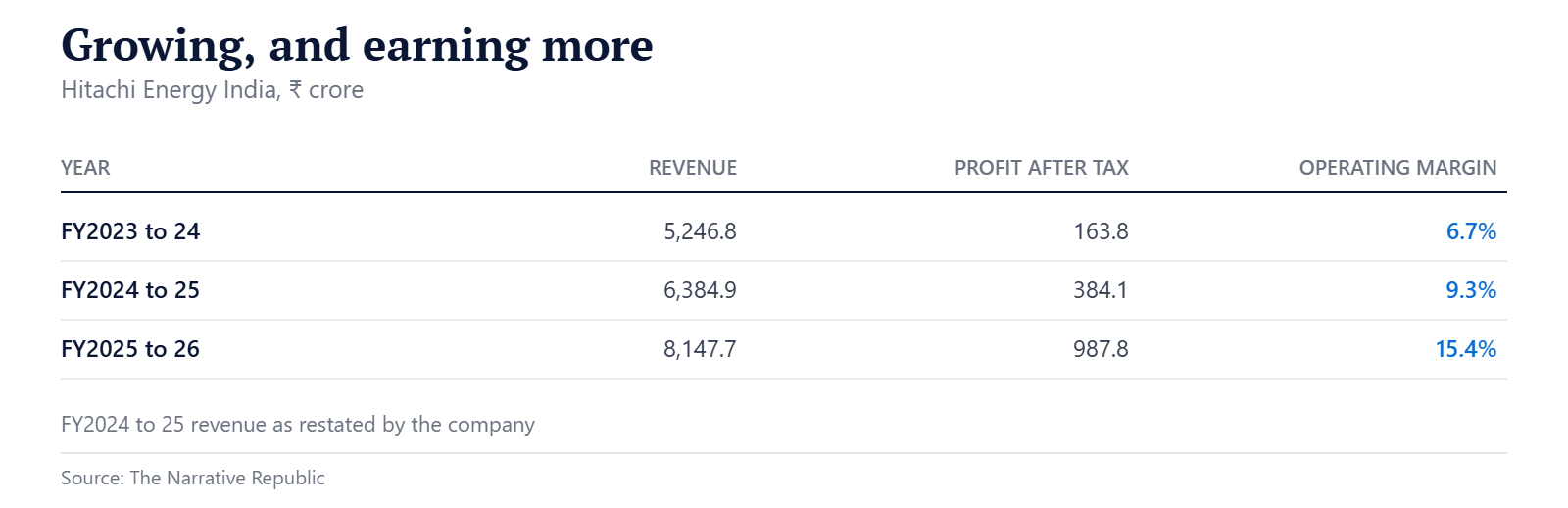
Growth has been fast and profitable. Revenue rose from ₹5,246.8 crore in 2023 to 2024 to ₹8,147.7 crore in 2025 to 2026. Profit after tax went from ₹163.8 crore to ₹987.8 crore over the same period, and the operating margin widened from 6.7% to 15.4%. That last figure matters most: the company is not just selling more, it is earning far more on each rupee of work.
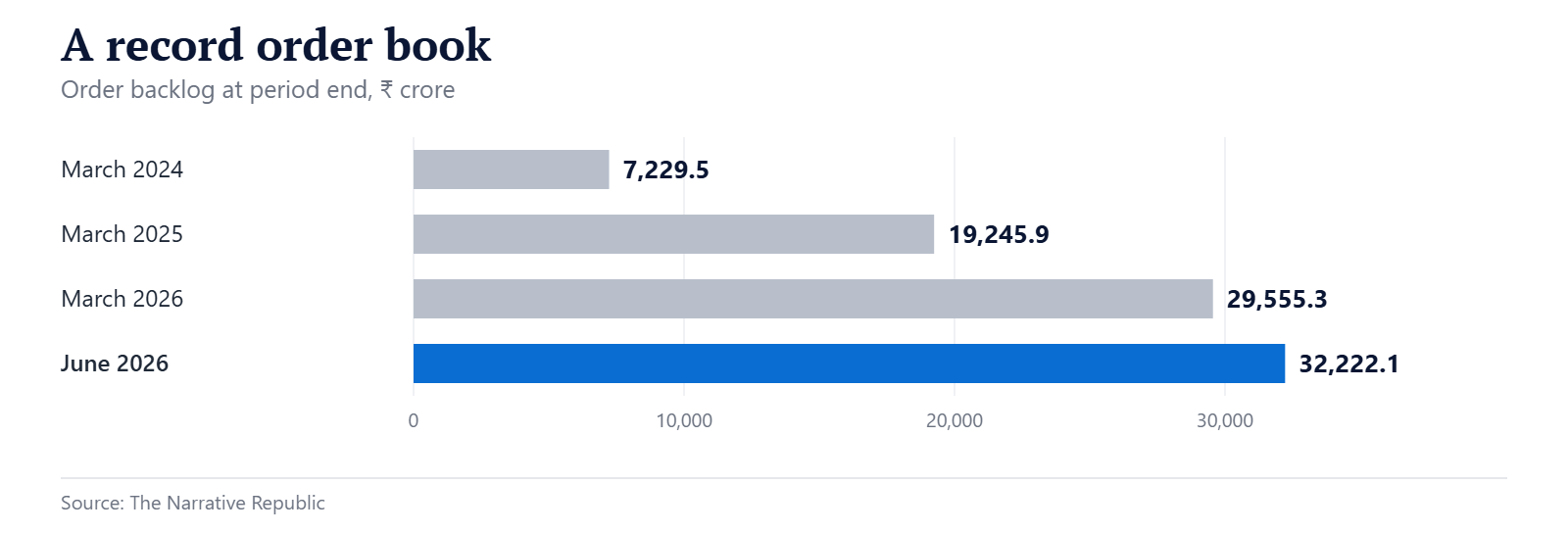
The order book tells the forward story. It stood at ₹7,229.5 crore in March 2024, jumped to ₹19,245.9 crore a year later as a large HVDC contract landed, and reached ₹32,222.1 crore by June 2026. In the April to June 2026 quarter alone, revenue rose 68.6% to ₹2,493.7 crore and profit more than doubled to ₹294.2 crore.
Building capacity to match
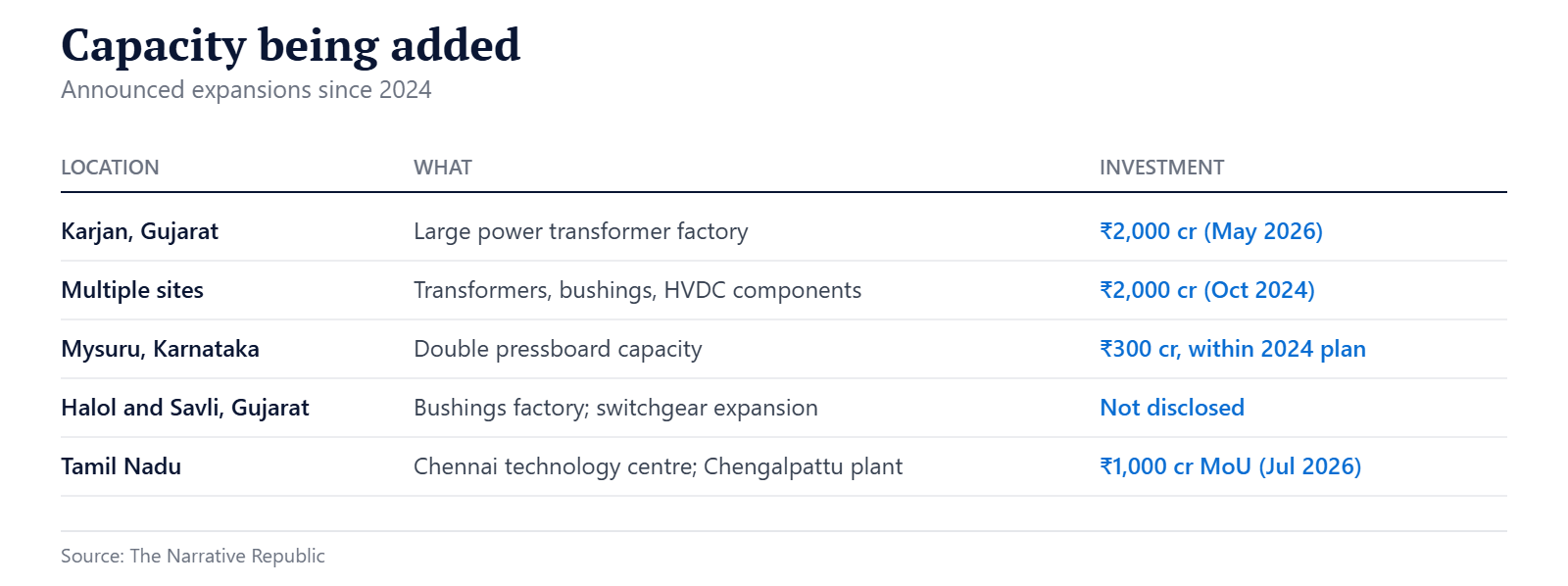
The company is investing ahead of demand. In October 2024 it set out a ₹2,000 crore capacity plan covering transformers, bushings and HVDC components. In May 2026 it approved another ₹2,000 crore, largely for a greenfield large power transformer factory at Karjan near Vadodara, taking its announced investment to ₹4,000 crore. The Gujarat chief minister attended the groundbreaking in June, and the plant is expected to create more than 1,000 direct and indirect jobs.
Around that, it has laid foundations for a bushings factory at Halol, expanded switchgear making at Savli, and committed ₹300 crore, as part of the 2024 plan, to double insulation pressboard capacity in Mysuru. In Tamil Nadu, the group signed a ₹1,000 crore agreement with the state government in July 2026 covering its technology centre and manufacturing at Chengalpattu, with 1,000 high skill jobs planned over three to five years.
The national push it rides on
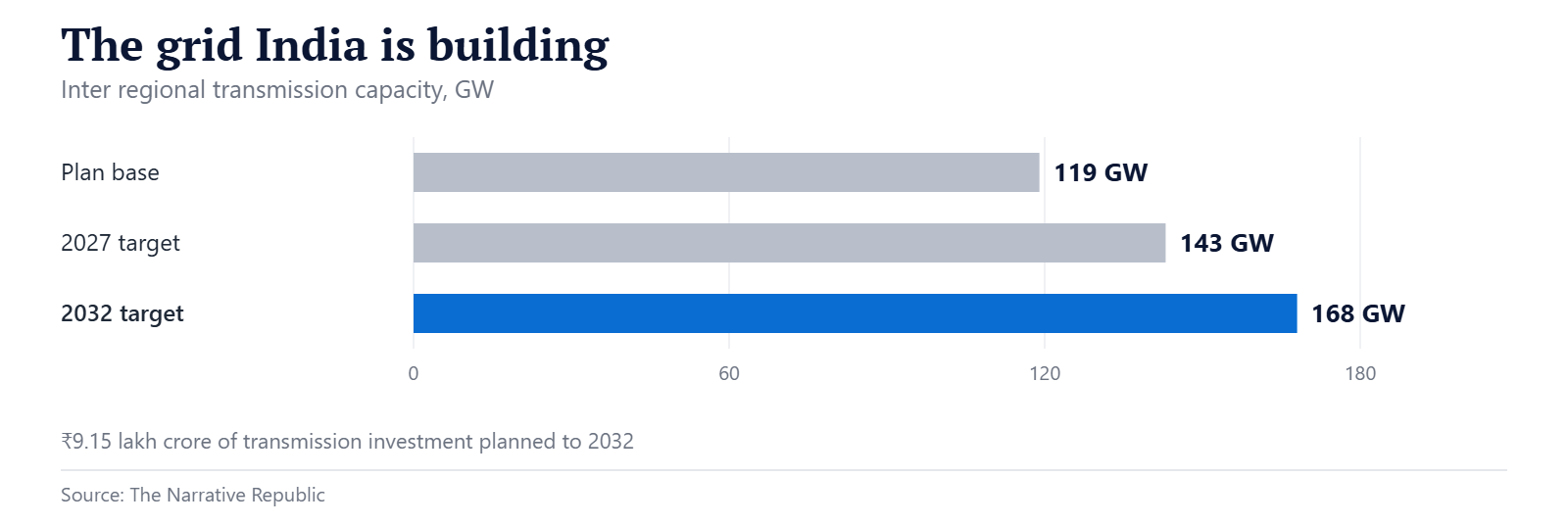
Hitachi Energy’s growth rests on a deliberate national programme. The government’s transmission plan to 2032 calls for investment of more than ₹9.15 lakh crore, about 1.9 lakh circuit km of new lines and an increase in capacity between regions from 119 GW to 168 GW. India’s transmission network crossed 5 lakh circuit km in January 2026, and non fossil generation capacity reached 300.5 GW by July 2026, more than 60% of the way to the 500 GW goal for 2030.
Policy is also widening the market. The Green Energy Corridor’s second phase, worth ₹12,031 crore, has been building lines within states to evacuate renewable power. Viability gap funding of ₹5,400 crore is supporting 30 GWh of battery storage, a segment where Hitachi Energy won its first Indian order in the April to June 2026 quarter, a 165 MW, 330 MWh project in Andhra Pradesh. Large HVDC tenders, including Khavda to Nagpur and Bhadla to Fatehpur, both won with BHEL, have given the company years of visible work. State governments have backed the build too, with Gujarat and Tamil Nadu hosting its biggest new investments.
Data centres are the next opening. The company says its grid to rack offering now covers about 30% of a typical data centre’s spending, up from 10 to 15% before, from the grid connection down to power at the server rack. A government white paper puts India’s data centre capacity at about 960 MW at the end of 2025 and projects about 9.2 GW by 2030, so the offering widens the company’s market well beyond utilities.
Where the gaps are
Execution is the first test. The order book is about three and a half times annual revenue, and the largest HVDC jobs run to 2029 and 2030. Analysts note that HVDC work carries lower margins than products, so the mix will shape profits as those projects move through. New capacity can take three to four years to build, which means today’s demand has to be met largely with today’s capacity.
Supply is the second. By 2025, lead times for high voltage equipment, including transformers, had stretched to close to 20 months, and transformer costs have roughly doubled in seven years. That tightness supports pricing for established makers, but it also strains their own supply chains and puts schedules at risk.
Competition is the third. Rivals are expanding too. GE Vernova’s Indian unit had an order book of about ₹20,930 crore and Siemens Energy India about ₹19,331 crore at the end of June 2026, and Siemens Energy India has announced a 30,000 MVA power transformer factory. BHEL is both partner and competitor. Leadership will depend on delivery records as much as on technology.
The fourth is dependence on the pace of public tendering. Much of the HVDC work comes through Power Grid and transmission projects awarded by competitive bidding, so timing rests on national planning. The Ladakh link, first planned as HVDC, drew a single bid and is now being redesigned as an AC line, which shows that tenders can shift.
What both sides gain
For India, Hitachi Energy brings HVDC and transformer expertise that few companies possess, built locally and increasingly exported. Its factories and engineering centres anchor supplier networks in Gujarat, Karnataka and Tamil Nadu, and its Chennai engineers work on grids around the world.
For Hitachi Energy, India offers one of the largest grid build outs anywhere, a deep engineering talent pool and a cost base that makes Indian factories competitive in export markets. The country is both a market and a manufacturing platform.
What to watch
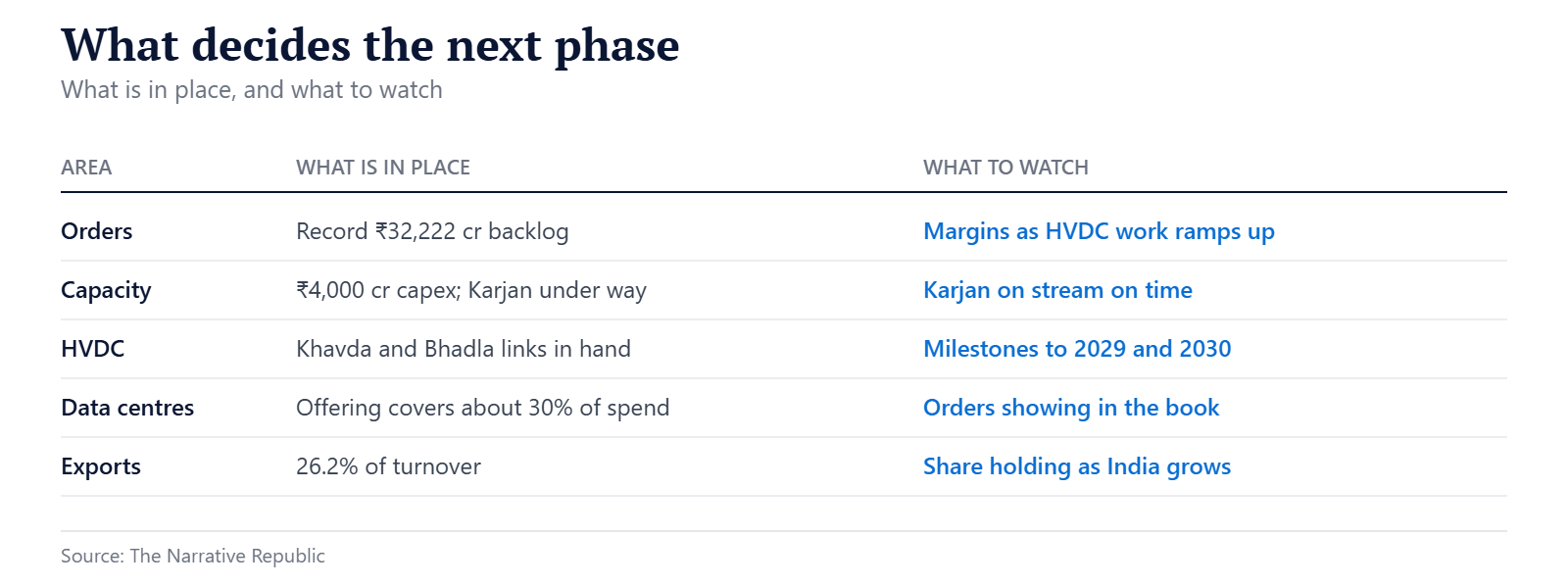
Results for July to September 2026 are due by mid November and will show whether margins hold as large projects move into execution. Beyond that, three signals matter: whether the Karjan factory comes on stream on time, whether HVDC milestones are met, and whether data centre orders begin to show up in the order book.
Hitachi Energy’s roots in India go back to 1949, long before the current wave of foreign investment. India’s grid ambitions have now caught up with that bet. Delivering the record order book on time will decide how much more it pays.
Also read: Tamil Nadu Keeps Winning Factory Investment. Now It Has to Win Every Expansion
Also read: How Andhra Pradesh Won Google’s $15 Billion Vizag AI Hub, and What It Takes to Make It Pay