

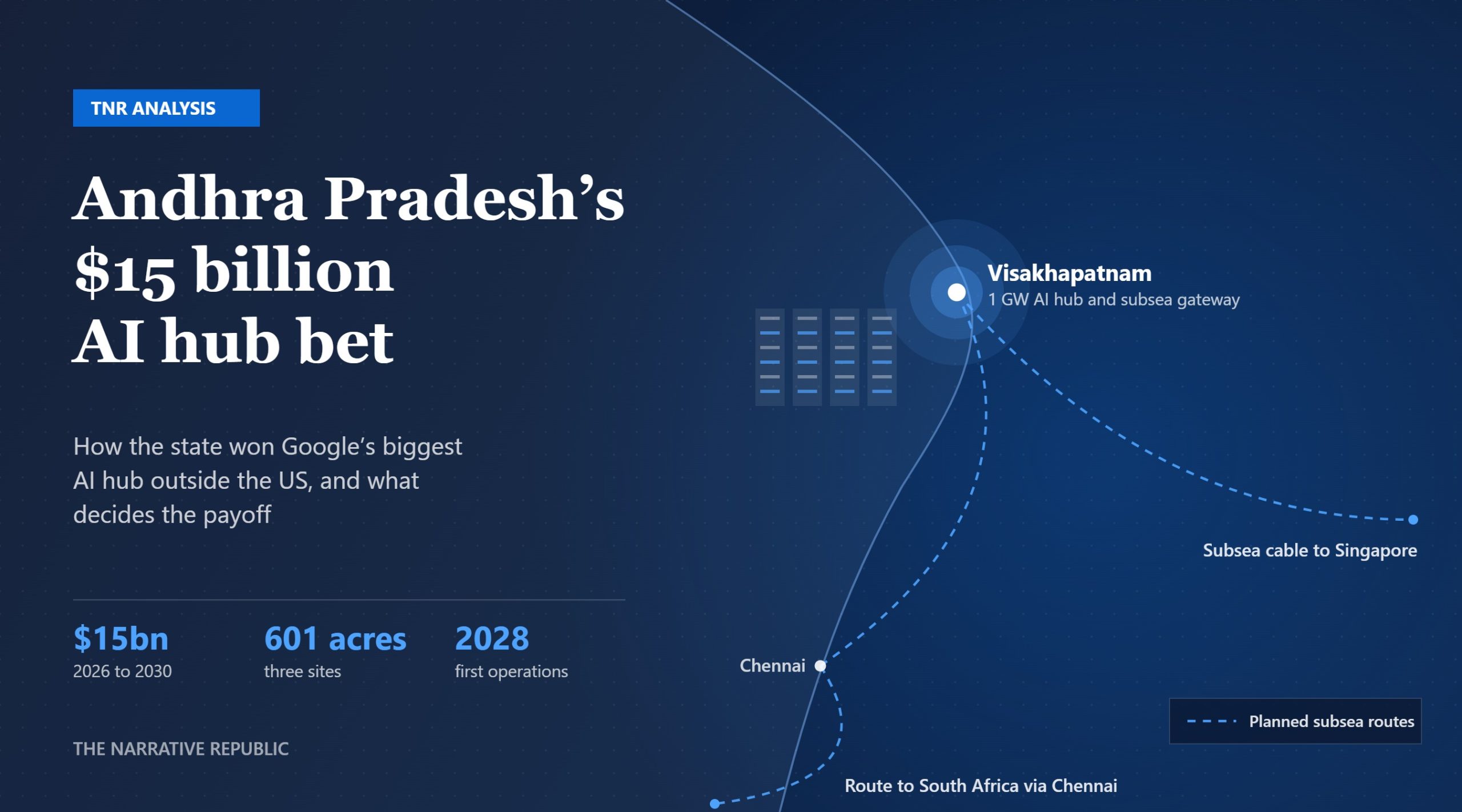
Andhra Pradesh has won the hardest part of the contest. Google chose Visakhapatnam for its first AI hub in India, a commitment of about $15 billion between 2026 and 2030. Google Cloud’s chief executive, Thomas Kurian, has called it the largest AI hub the company is investing in anywhere outside the US. Ground was broken in April, and Google expects the first operations in 2028.
The state put together land, power arrangements, incentives and fast approvals for a single project, and the Centre added a tax framework that favours exactly this kind of investment. The task now is execution: keeping clearances, power, water and the investors following Google on track so that a landmark announcement delivers on the ground.

What Google is building
Google announced the hub on 14 October 2025. The plan has four parts: a gigawatt scale data centre campus, a new international subsea gateway, an expanded fibre network, and new clean energy, transmission and storage built with local partners.
The work is shared with Indian partners. AdaniConneX, a joint venture of Adani Enterprises and EdgeConneX, and Nxtra by Airtel are building the data centre structures and connecting infrastructure. Airtel is also building the cable landing station in the city. The Adani Group said in late November 2025 that it plans to invest up to $5 billion in the project.
The hub is spread across three campuses on about 601 acres: 266.6 acres at Tarluvada, about 175 acres at Rambilli and Achyutapuram in Anakapalli district, and 160 acres at Adavivaram. The state raised the allotment from 480 acres in February 2026. The land has been allotted to Adani Infra (India), a partner named for Raiden Infotech India, the Google company behind the project.

Groundbreaking took place at Tarluvada on 28 April 2026, with the chief minister and the Union IT minister present. The commissioning target for the data centres is July 2028, and the $15 billion is due to be spent by 2030.

Google is not new to India or to the state. It has more than 10,000 employees in the country, cloud regions in Mumbai and Delhi, and a $10 billion digitisation fund announced in 2020. Google Cloud provides the infrastructure for iGOT Karmayogi, the government’s online training platform for more than 20 million public servants. In December 2024, well before the hub was announced, Google signed an agreement with the Andhra Pradesh government to support AI adoption, offering 10,000 certificates for its AI Essentials course and cloud skilling for state agencies. Its company profile in our directory tracks that wider footprint.
Why the cables matter as much as the servers
The subsea gateway is the part most likely to outlast any single data centre. In 2025 India had 17 international cables landing at 16 stations, and most came ashore along a six kilometre stretch of beach at Versova in Mumbai, with Chennai the other main gateway. That concentration is a known weak point for a country whose digital economy runs on these links.
In February 2026 Google set out how Vizag fits in. Its America India Connect plan adds a direct subsea path from Visakhapatnam to Singapore and a fibre route via Chennai to South Africa, as part of a wider network linking India with the United States. Google describes Vizag as a major international subsea gateway, adding to the existing landings in Mumbai and Chennai. If they are built as described, the routes would add new international links from the east coast and give Vizag a role in national digital infrastructure.
Google’s planned 1 GW compares with about 1,789 MW of operational data centre capacity across India’s top seven data centre markets in the first half of 2026, a count that does not yet include Visakhapatnam. Built at full scale, one project of this size would shift where the country’s computing capacity sits. Google also estimates the hub will generate about $688 million a year in local economic activity.

What it means for Indian businesses
The hub is not only a server farm for Google’s own products. The company says Vizag will let it deploy its full AI stack in India, built on the same infrastructure that runs Search, Workspace and YouTube, and deliver the high performance, low latency services that businesses and organisations need. It has also promised long term support for businesses and startups in the state.
For Indian banks, insurers, startups and public agencies building AI into their services, computing capacity close to their users means faster responses and more room to scale at home rather than relying on capacity abroad. That is the commercial case behind the hub, and it is why its success matters well beyond Andhra Pradesh.
How the state built the case
The state moved quickly. Google announced the hub in October 2025, the state approved its incentive package the same month, and ground was broken in April 2026. In April 2026 the state cabinet cleared a power distribution licence for Raiden, and an energy department order now allows data centres with a connected load of 300 MW or more to hold such a licence and arrange their own supply. Andhra Pradesh has been described as the first state to take this step. It keeps the burden of sourcing a very large new load with the developer rather than the state’s distribution companies.
The groundwork goes beyond one project. The state has published a phased transmission plan to carry more than 15 GW of data centre load by 2034, and its clean energy policy targets more than 160 GW of renewable capacity. The state IT minister has said 70% of the energy for its data centres will come from renewables, and that agreements covering the state’s 6.5 GW data centre target are in place. Its investment board cleared proposals worth more than ₹2 lakh crore at each of two meetings in May and August 2026.

Infrastructure is falling into place. The new Alluri Sitarama Raju International Airport at Bhogapuram, inaugurated on 1 August 2026, began commercial flights on 17 August, with capacity for 6 million passengers a year in its first phase. On land, the state says eligible residents have been compensated and that new housing is being built; families at Tarluvada have reported receiving about ₹40 lakh an acre.
The Centre has backed the same direction. This year’s Union Budget offers a tax holiday until 2047 to foreign companies that serve global customers using data centre services in India, with a 15% safe harbour margin where the Indian data centre company is a related party. Because Raiden, the Indian company behind the project, is part of Google, the provision makes Vizag a more attractive base from which to serve Google’s customers around the world.
What the state is offering, and the arithmetic
The state approved a tailored incentive package for Raiden Infotech India in October 2025, worth ₹22,002 crore against a recorded investment of ₹87,520 crore across Visakhapatnam and Anakapalli districts. It includes a 25% discount on land, a full exemption from stamp duty and registration charges, a 10% capital subsidy on plant and machinery, reimbursement of state GST on construction capped at ₹2,245 crore, and a power discount of ₹1 per unit capped at ₹4,800 crore.

The package works out to about a quarter of the recorded investment. That is generous, and it is the price of competing for the largest projects. Three of the five main items, the capital subsidy, the GST reimbursement and the power discount, are tied to investment actually made or power actually consumed, so much of the payout depends on what gets built. The sharper test is visibility: a yearly public scorecard on capital deployed, jobs, local suppliers and tax revenue against the incentives drawn would show the trade is working and strengthen the state’s hand with the next investor.
The followers
The case for Andhra Pradesh rests on Google acting as a magnet, and the approvals point that way. Since Google’s announcement the state has approved large data centre projects from Reliance, ReNew, Sify and CtrlS, and in June 2026 state officials counted 16 large projects in the region with about 9.1 GW of planned load.
For context, Mumbai, India’s largest data centre market, had about 890 MW of operational capacity in the first half of 2026, and Chennai about 214 MW. Even a modest share of the Vizag pipeline, once built, would make north coastal Andhra Pradesh one of India’s larger data centre clusters.

Approvals are not yet buildings. Reports linking Meta to the Sify project as a tenant have not been confirmed by either company. In March 2026 the state invited Capgemini to set up an IT development centre and capability centre in Vizag, with a potential of around 20,000 jobs; the company said it would examine the proposals. Capgemini’s existing India operations are in our directory, and centres that open in the state will appear on our India GCC Tracker and the Andhra Pradesh policy page. These approvals face the same test as India’s wider data centre pledges: how much converts from signed paper into working capacity.
Where the gaps are
Power is the binding constraint. The state’s own order said Google’s facility at full capacity would use electricity equal to nearly half of Mumbai’s annual consumption. Andhra Pradesh’s peak demand reached 15,016 MW in May 2026, while the data centre projects counted in the region add up to about 9.1 GW of planned load. Even if only part of that is built, the transmission and renewable plans will need to arrive on schedule. The distribution licence model helps by putting sourcing on the developers, but the grid connections still run through the state.
Water is the second test, and Google has moved early on it. The clearance for the Adavivaram site covers 307 kilolitres of water a day and 512 MW of power, with 100 standby generator sets, and the site sits about 120 metres from Mudasarlova reservoir. Google says it chose air cooling for the campus after its own assessment found the local watershed under pressure, and across its operations it has pledged to replenish 120% of the freshwater it uses by 2030. The state IT minister has said the region’s data centres would need about 3 TMC of water a year once they reach the 6.5 GW target.
Clearances are the third. The Andhra Pradesh High Court is hearing a petition challenging the environmental clearance for the Adavivaram site and the use of temple land there. The clearance, granted on 5 June 2026, used the building and construction category because data centres are not listed separately under the 2006 environmental impact rules. The court has allowed work to continue, at the developer’s own risk and cost, and has asked the Centre, the state and the developer to file replies; the National Green Tribunal has also sought the Centre’s response. The state says the temple land was leased, not transferred, and earns the temple about ₹26 crore a year. A clear national category for data centres in the environmental rules would give every state, and every investor, more certainty.
Jobs are the fourth, and the most misunderstood. Data centres are capital heavy and light on permanent staff. Google says a typical build employs about 4,200 construction workers a year over three to five years, followed by hundreds of specialist roles once a site runs. The state’s projection of 188,000 direct and indirect jobs depends on the wider chain: cloud and AI services, capability centres, startups, maintenance, logistics and power. That is where the 10,000 AI certificates and future skilling programmes matter, because the region will capture those jobs only if local talent is ready for them.
What both sides gain
For Google, Vizag offers what is hard to assemble elsewhere: large contiguous land, a coastline suited to cable landings, a fast moving state government and a national tax regime that favours serving global customers from India, all inside one of its biggest user markets.
For India, it spreads digital infrastructure beyond the established hubs and gives domestic businesses AI capacity at home. For Andhra Pradesh, it is a chance to build a digital economy in a region known more for ports and steel, with a new airport open, transmission lines planned and land banks allotted.
Where this goes next
Four things will decide how this story is judged: whether the clearances are settled, whether power and water supply grow with the campus, whether the Reliance, Sify, CtrlS and ReNew approvals turn into buildings and payrolls, and whether local talent is ready for the jobs that follow.

On the evidence so far, the state has put the main pieces in place and the anchor investor is building. If the cables land as Google has described and the followers convert, Visakhapatnam becomes India’s newest international gateway and a computing hub for the region, and the ₹22,002 crore incentive bill is likely to look like a sound trade. The next three years will show how much of that potential Andhra Pradesh turns into lasting growth.
Also read: Google breaks ground on its ’5 billion Visakhapatnam AI hub, its largest outside the US
Also read: AirTrunk to Invest $30 Billion in India by 2030 to Build 5 Gigawatts of Data Centre Capacity
Also read: Meta to Lease AI Data Centre Built by Reliance in Jamnagar