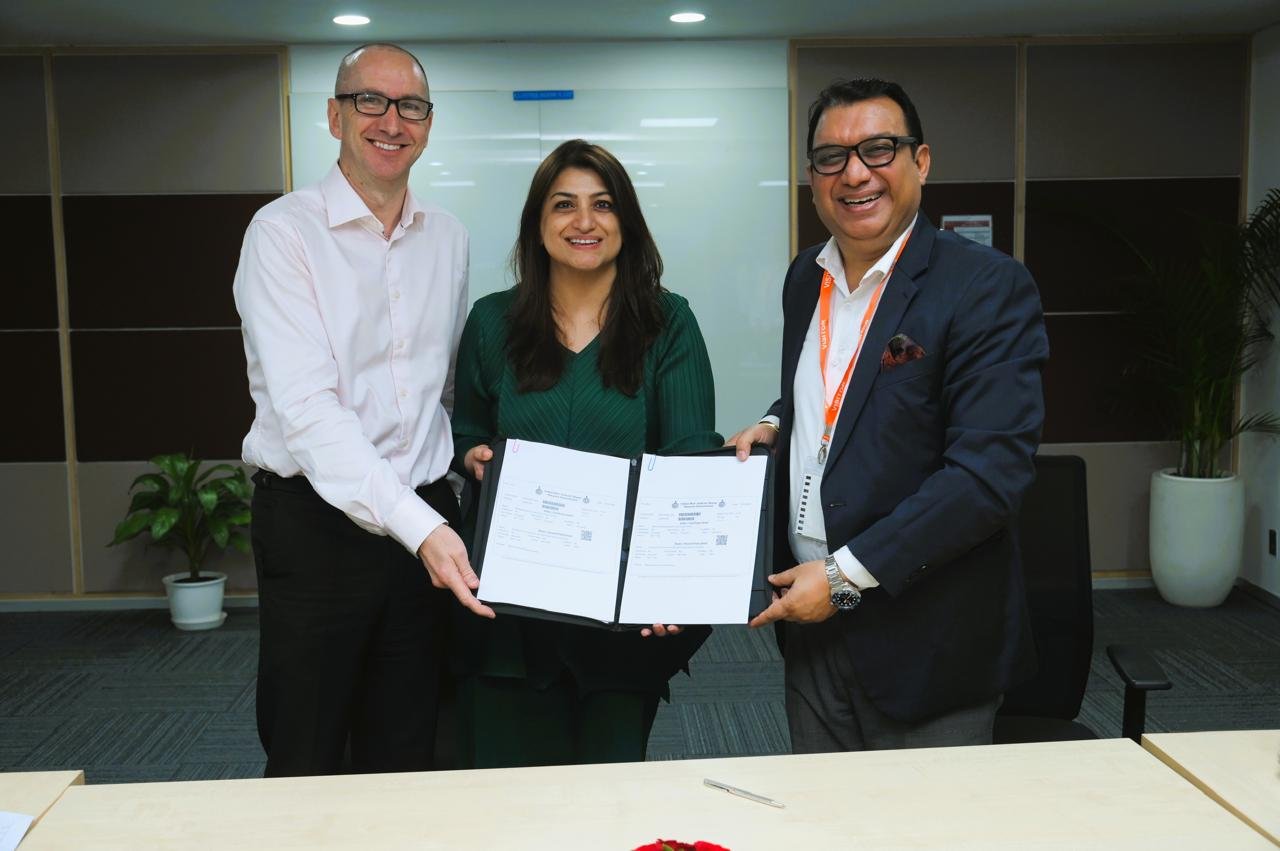
NatWest Group has formalised a research and innovation partnership with the Indian Institute of Technology Delhi, working through IIT’s Foundation for Innovation and Technology Transfer — marking the first time FITT has entered such a collaboration with a global bank. The agreement, announced on April 28, 2026, covers joint research and pilot projects across artificial intelligence, fintech, cybersecurity, and other emerging technologies, and signals a deliberate effort by the British banking group to embed itself within India’s academic and startup ecosystem rather than simply draw talent from it.
The partnership is structured around applied research — taking ideas developed in academic settings and testing them against real business problems within NatWest’s operations. It will involve researchers, students, and startups working alongside NatWest colleagues, with the stated aim of accelerating innovation in customer experience, data, and AI. For IIT Delhi, the arrangement creates a direct channel between its research community and one of the UK’s largest financial institutions. For NatWest, it provides structured access to early-stage thinking on the technologies most likely to reshape banking over the next decade.
Scott Marcar, Chief Information Officer of NatWest Group, framed the strategic rationale directly: “Working with leading universities like IIT Delhi helps us to shape the next generation of technology talent and the direction of innovation, strengthens our long-term ability to keep evolving, and supports our work to make banking simpler, safer and more effective for our customers.”
The announcement carries additional weight coming from Ruchika Panesar, who holds dual responsibilities as Country Head for India and Chief Digital and Information Officer for Group Functions at NatWest. Her presence in both roles reflects how central India has become to the bank’s technology and innovation architecture. Panesar described India as “a strategic engine for NatWest’s technology, innovation and future growth, powered by the depth and quality of talent here,” and pointed to the IIT Delhi partnership as a means of strengthening the talent pipeline while deepening engagement with the academic and startup ecosystem.
Dr Nikhil Aggarwal from FITT-IIT Delhi described the collaboration as a model where “innovation moves beyond labs into scalable solutions, while nurturing talent that is ready to solve complex global challenges” — a formulation that captures what distinguishes this kind of arrangement from conventional campus recruitment. The intent is not simply to hire IIT graduates earlier in their careers but to shape the research agenda itself, directing academic attention toward problems that have commercial and operational relevance within a large financial institution.
The focus areas — AI, fintech, and cybersecurity — are not incidental. They map directly onto the functions that global banks are most aggressively building in their India GCCs right now. NatWest’s India operation already handles significant technology and digital work for the group, and the IIT Delhi partnership extends that footprint into the research layer, creating a longer runway for capability development than hiring alone can provide.
The timing also matters. As multinational banks increasingly compete for the same pool of senior AI and data science talent in Bengaluru, Hyderabad, and Pune, those with established academic partnerships gain access to talent earlier — and with stronger institutional alignment — than those relying purely on lateral hiring. The IIT network, with its dense connections to India’s technology startup ecosystem, adds a further dimension: NatWest gains visibility into early-stage ventures that may become relevant to its innovation agenda before they are widely known.
For India’s broader GCC and fintech ecosystem, the NatWest-IIT Delhi tie-up represents a maturing of how foreign financial institutions think about their India presence. The progression — from offshore delivery to captive GCC to embedded academic partnership — is becoming a recognisable pattern among the more sophisticated players. Building a research relationship with a premier engineering institution is not a short-term hire. It is a structural bet on India’s capacity to generate the ideas, not just execute them.