New Delhi: Hyundai Motor Group will invest $15.5 billion in India from 2026 to 2032, the South Korean carmaker said on October 13, 2026. The plan was discussed that day when Executive Chair Euisun Chung met Prime Minister Narendra Modi at the Prime Minister’s Office.
The money will go into four areas over seven years: more manufacturing capacity, research and development (R&D) infrastructure, local suppliers for parts localisation, and future technology. The group called India a strategic core market for its growth, its push into emerging markets and its next generation vehicle technology.
A dedicated investment entity will be set up in India to run the programme. It will coordinate spending on R&D, future technologies and the wider automotive ecosystem, scout for local partners and suppliers, and support strategic partnerships.
“India remains one of Hyundai Motor Group’s most important and strategic markets globally. The past 30 years have been defined by our commitment to India. This investment reaffirms our commitment to India for the next 30 years and beyond. Through this investment, we will create more employment opportunities and work together with our partners and stakeholders to support India’s continued industrial development,” Chung said.
Factories, research and suppliers
Hyundai plans to add capacity at Hyundai Motor India Limited and Kia India Pvt. Limited to support significant volume growth, with output localised for the Indian market. The group expects India to become one of its leading global export platforms.
Research gets about $700 million, earmarked for the group’s Indian R&D centre, including its vehicle testing track. Hyundai wants a complete R&D system in the country, built on new infrastructure and local talent, to speed up next generation vehicle technology and make India a core innovation hub.
On the supply side, the group will invest in regional partners to deepen parts localisation and build a more resilient supply chain. It will also back high potential startups, expand into mobility services linked to its vehicle business, and explore specialised automotive financing, EV charging infrastructure and end of life vehicle recycling.
Pune plant opens a day later
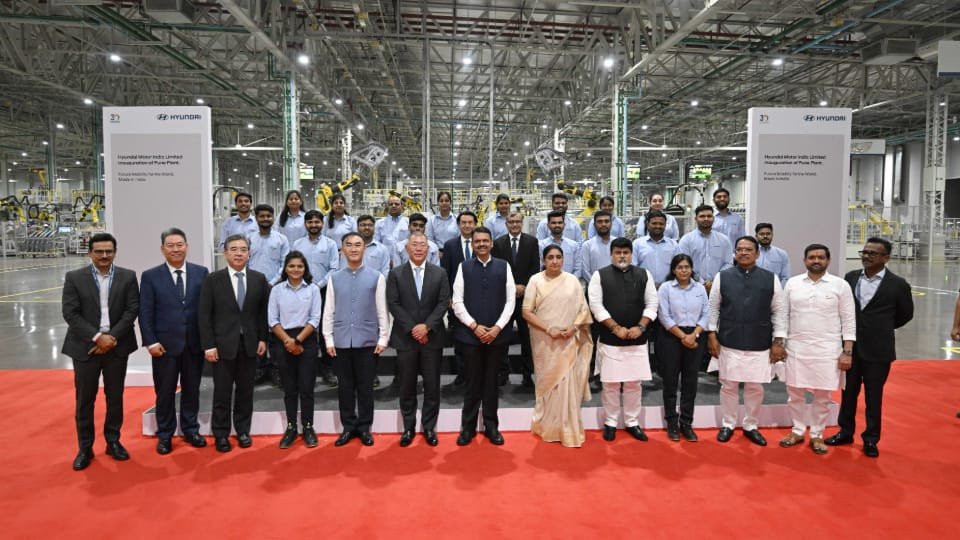
The first visible step came on October 14, when Hyundai Motor India formally opened its new plant at Talegaon in Pune, Maharashtra. Chief Minister Devendra Fadnavis inaugurated the facility, which starts with capacity for 170,000 vehicles a year. That is set to rise in phases to 320,000 units by 2030, and the site also has an engine shop that can build 150,000 engines a year.
Pune will build the new Hyundai Venue solely for global markets, with exports planned to more than 35 countries. The company also marked 4 million cumulative passenger vehicle exports from India since 1999, the first carmaker in the country to reach that figure.
“We will invest INR 11,000 crore in phases at this facility,” said Tarun Garg, Managing Director and CEO of Hyundai Motor India. He added that 55 supplier partners have already invested nearly INR 4,600 crore in the state and, together with tier II vendors, have created more than 18,000 jobs in Maharashtra.
Where Hyundai stands today
Hyundai Motor Group already employs more than 24,000 people in India. It expects the investment to create jobs across manufacturing, R&D, engineering and supply chains, as well as among suppliers and new mobility ventures, though it did not put a group wide number on them.
With Pune running, the group can build more than 1.4 million vehicles a year in India. Hyundai Motor India’s Chennai plant accounts for 824,000 units, Kia India’s Anantapur plant for 431,000 and Pune for 170,000.
Affiliates Hyundai Mobis, Hyundai Transys, Hyundai Capital, Hyundai Wia and Hyundai Glovis run component and service operations in the country. The group also runs the Samarth campaign on disability inclusion and plans a vocational training institute in Chennai, the Hyundai Academy for Technical Skills (HATS). Its major affiliates have contributed about $110 million to social welfare, education, skill development and community programmes in India since 2016.
South Korean companies in India
- Hyundai Motor India listed on the NSE and BSE in October 2024 and runs plants in Chennai and Pune.
- Kia India builds 431,000 vehicles a year at Anantapur in Andhra Pradesh.
- Samsung makes phones in Noida, one of its biggest factories worldwide, has a second plant at Sriperumbudur, and runs its largest R&D centre outside South Korea in Bengaluru.
- LG Electronics India listed on the NSE and BSE on October 14, 2025.
- POSCO signed a 50:50 joint venture with JSW Steel in April 2026 for a 6 million tonne a year integrated steel plant in Odisha, due for completion in 2031.
The Narrative Republic: Growing With India
Our analysis
For India, the weight of this plan sits in two places: exports and suppliers. Hyundai wants India to become one of its leading global export platforms, and Pune shows what that means in practice: a model built here only for buyers in more than 35 overseas markets.
The supplier push could matter even more. By investing in regional partners and deepening parts localisation, Hyundai would keep more of each vehicle’s value inside the country. Pune already offers a preview, with 55 suppliers putting nearly INR 4,600 crore into Maharashtra.
The $700 million for R&D points the same way. A complete research system and a testing track in India mean more engineering on future models can happen here, not only assembly.
What India does not yet have is a group wide number for new jobs or added capacity. The size of the gain will depend on how fast Pune reaches 320,000 units and which companies the new investment entity backs first.
What will do more for India over the next decade: Hyundai’s export push or its investment in local suppliers?