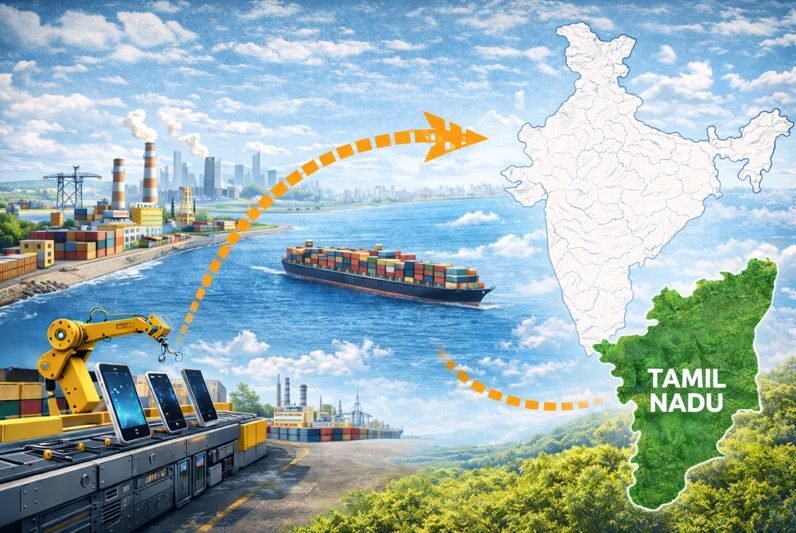
Tamil Nadu did not become India’s manufacturing capital by accident. It took decades of getting the basics right. Now, as global companies move supply chains away from China, they are finding Tamil Nadu already built for it.
When global manufacturers started acting on their China+1 plans, most expected to spend years searching for the right location. Many of them found Tamil Nadu had been waiting.
The state has spent decades building what manufacturers actually need: a deep supplier base, export infrastructure, engineering talent, and a government that understands industry. That foundation is now paying off as companies restructure supply chains at speed.
Foxconn has expanded assembly near Chennai as Apple accelerates iPhone production in India. The Sriperumbudur corridor is now the operational centre of Apple’s India manufacturing push. Localisation rates are rising and production capacity is growing quarter by quarter.
Hyundai operates one of its largest overseas plants near Chennai, producing for both India and export markets. Since entering India, it has exported over 3 million vehicles to Africa, Latin America, the Middle East, and Europe. Tamil Nadu is not just a market for Hyundai. It is a global production base.
Daimler has maintained a significant manufacturing presence in Tamil Nadu for years. Its commitment predates the current wave of supply chain restructuring, which says something about long-term confidence in the location.
The French industrial group has expanded operations in southern India as part of its Asia strategy. Tamil Nadu’s engineering talent and established industrial base are central to that decision.
Tamil Nadu produced 41 percent of India’s electronics exports last year. That is not a statistic about potential. It is a statement about execution.
What Tamil Nadu Has That Others Do Not
Global manufacturers do not just ask whether a location is affordable. They ask whether it can scale. Tamil Nadu’s answer rests on four things newer industrial regions have not yet built.
A mature supplier base. Across automotive, electronics, and precision engineering, the ecosystem already exists. Components, tooling, logistics, specialist services. Companies can scale here because everything around them is already in place.
Export infrastructure that works. Chennai Port, Kamarajar Port, and Thoothukudi move the volumes that export-focused manufacturers need. For companies whose product leaves India rather than staying in it, this matters more than almost anything else.
Engineering talent at scale. Tamil Nadu produces thousands of engineering graduates each year across manufacturing, automation, electronics, and software. The pipeline is consistent and technically trained.
Policy that follows through. The state has built frameworks for electronics, electric vehicles, and advanced manufacturing aligned with India’s PLI schemes. In 2026 it added the Deep Tech Startup Policy and the Shipbuilding Policy, signalling that its industrial ambition is moving up the value chain.
What Comes Next
Tamil Nadu is now competing for semiconductor-adjacent manufacturing, defence production, and shipbuilding. These are higher-value categories with more strategic weight than consumer electronics assembly. The state is not resting on what it has built.
For global manufacturers evaluating an India move, the fundamentals in Tamil Nadu are settled. The question now is timing. Early movers have taken positions. The window for the best locations, the strongest partner ecosystems, and the most favourable policy incentives is closing.